Digital Procurement Automation in Manufacturing
In the manufacturing industry, speed plays one of the most pivotal parts and it means money. Every day a product waits for approval; competitors are already shipping theirs. Indian appliance makers facing global competition are discovering a hidden weapon as Digital Procurement Automation.
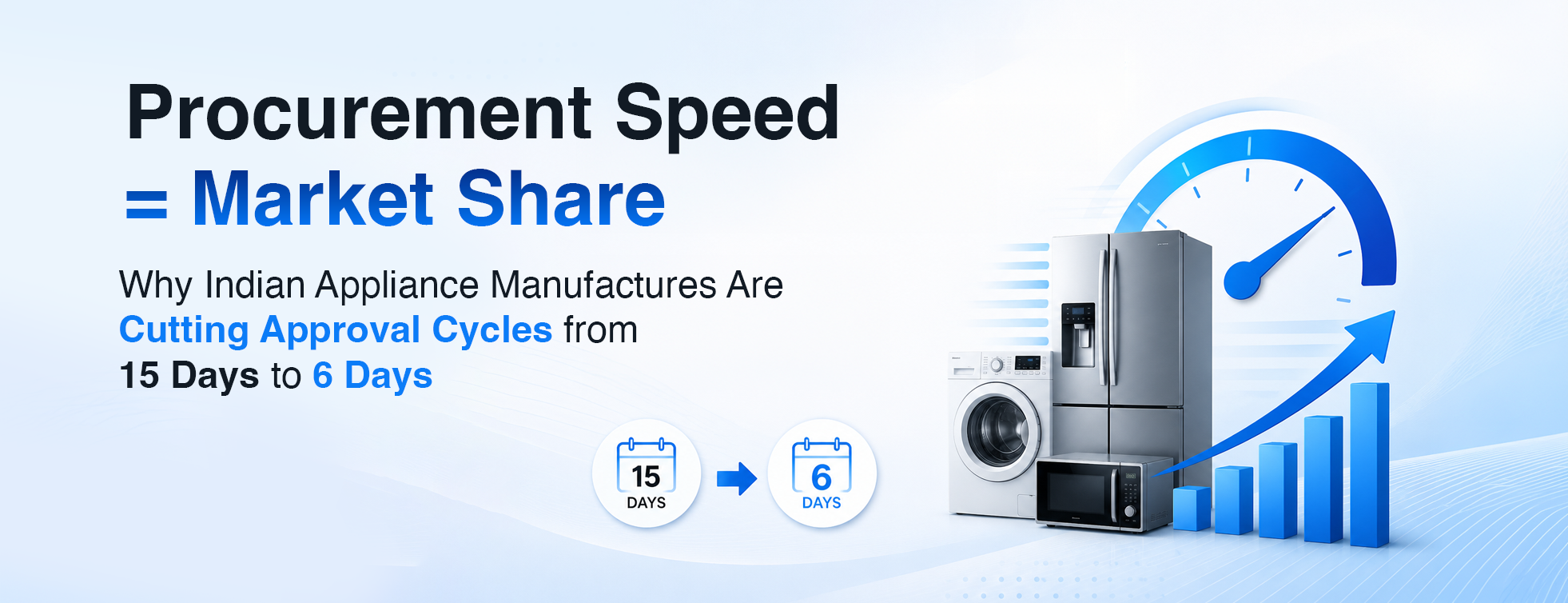
If we talk about Kutchina, as one of India’s largest appliance brands, cut procurement approval cycles from 15 days to 6 a 60% reduction. The impact was immediate: faster production, better inventory control, reduced carrying costs, and the ability to respond to market demand nine days ahead of rivals.
But approval speed is just the beginning. Digital Procurement unlocks:
- 40% cost reduction through vendor consolidation
- 100% inventory accuracy eliminating stockouts and overstock
- ₹8 Crore+ annual savings in operational efficiency
- 5x customer satisfaction improvement from faster delivery
The manufacturers have started embracing these changes and are capturing market share from competitors. They are either stuck in manual or email-driven processes. Now the question arises, whether to transform or how quickly you can do it?
Speed Decides the Winner
The scenario to analyze is imagining two appliance manufacturers eyeing the same market opportunity.
Manufacturer A, stuck with traditional email based procurement, takes 15 days to push approvals through. Manufacturer B, equipped with a digital procurement platform, completes the same cycle in just 6 days. The difference? Nine days.
Nine days may seem small, but in manufacturing, speed is money. While Manufacturer A waits, Manufacturer B is already shipping products, meeting demand, and capturing market share. Faster approvals mean smoother production, accurate inventory, lower carrying costs, and the agility to respond ahead of competitors.
If you think that the scenario is hypothetical, then I must say that it isn’t. It is reality shaping India’s manufacturing sector.
Brands like Kutchina have proven that digital procurement delivers measurable impact, setting up a new baseline for efficiency and competitiveness.
The question is no longer if digital transformation matters, but which approach is your company taking?
The Hidden Price of Slow Approvals
In manufacturing, every day of delay carries a measurable cost. The industry baseline for procurement approval cycles is 18–25 days, a timeline that is increasingly unsustainable in a market defined by speed. Each day an order is delayed translates into ₹5–10 lakhs in lost opportunity per order for a typical mid‑market manufacturer. Over the course of a year, this adds up to ₹2–5 Crore in lost productivity, draining profitability and eroding competitiveness.
The financial impact is only part of the story. Customer satisfaction suffers when approvals drag on, as delays increase the risk of order cancellations and missed delivery commitments. In industries where reliability defines reputation, even a single delay can damage long‑term relationships.
The competitive impact is even sharper. Manufacturers who digitize procurement and cut approval cycles are consistently winning contracts over slower rivals. Faster approvals mean faster production, better inventory control, and the ability to respond to demand ahead of competitors. Companies still relying on manual, email‑driven processes are not just inefficient, they are losing market share to those who have embraced automation.
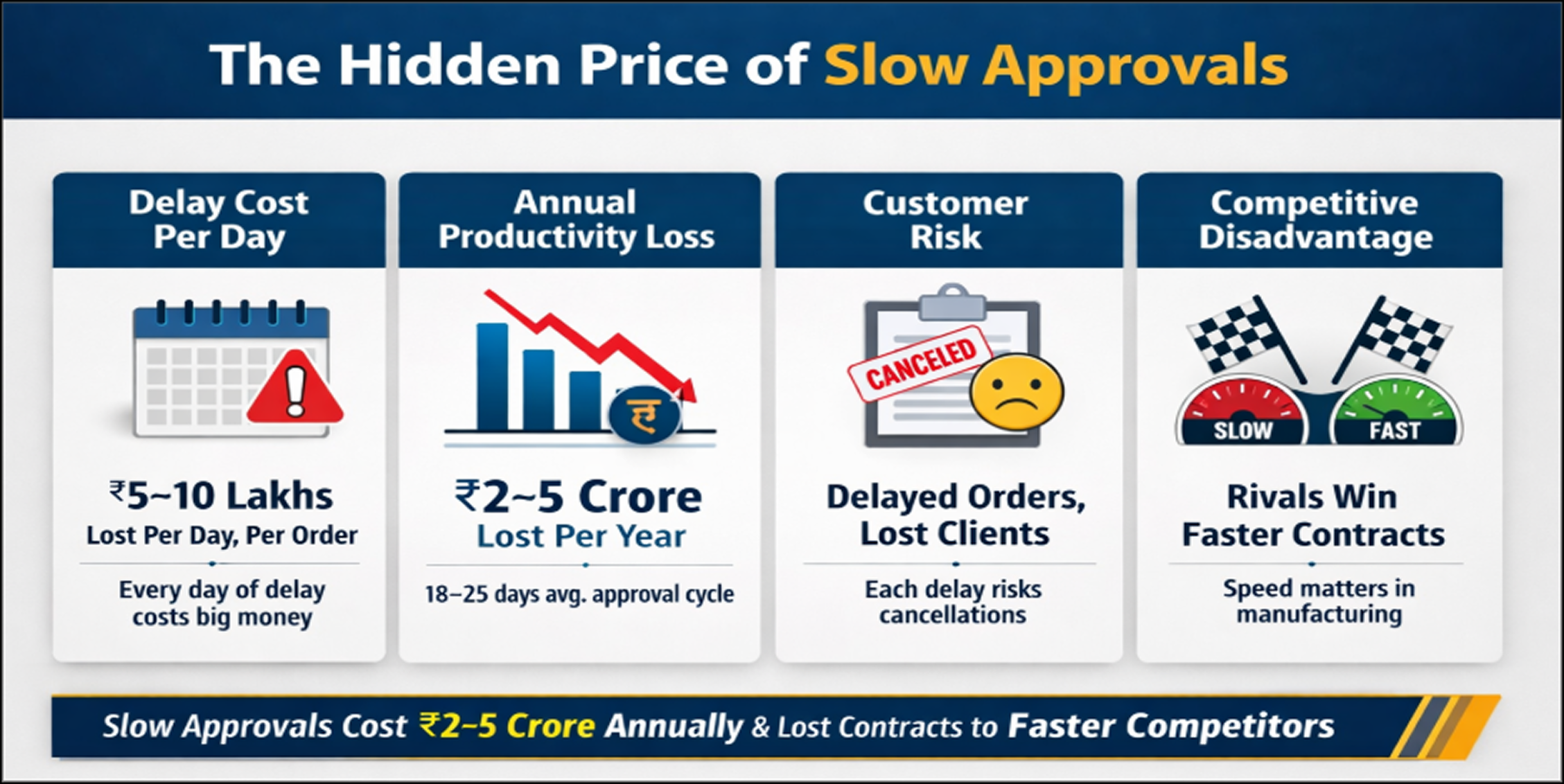
This Infographic Illustrates:
- Delay Cost Per Day → ₹5–10 Lakhs lost per order
- Annual Productivity Loss → ₹2–5 Crore lost per year
- Customer Risk → Delayed orders increase cancellations
- Competitive Disadvantage → Faster rivals win contracts
It’s designed to visually reinforce the urgency of shortening approval cycles, making it perfect for inclusion for this blog.
The approval cycle is no longer a back‑office metric; it is a frontline determinant of competitiveness. Manufacturers who shorten this cycle unlock savings, resilience, and customer loyalty. Those who fail to act risk falling behind in a marketplace where speed is the ultimate currency.
Kutchina’s Bottlenecks to Breakthroughs
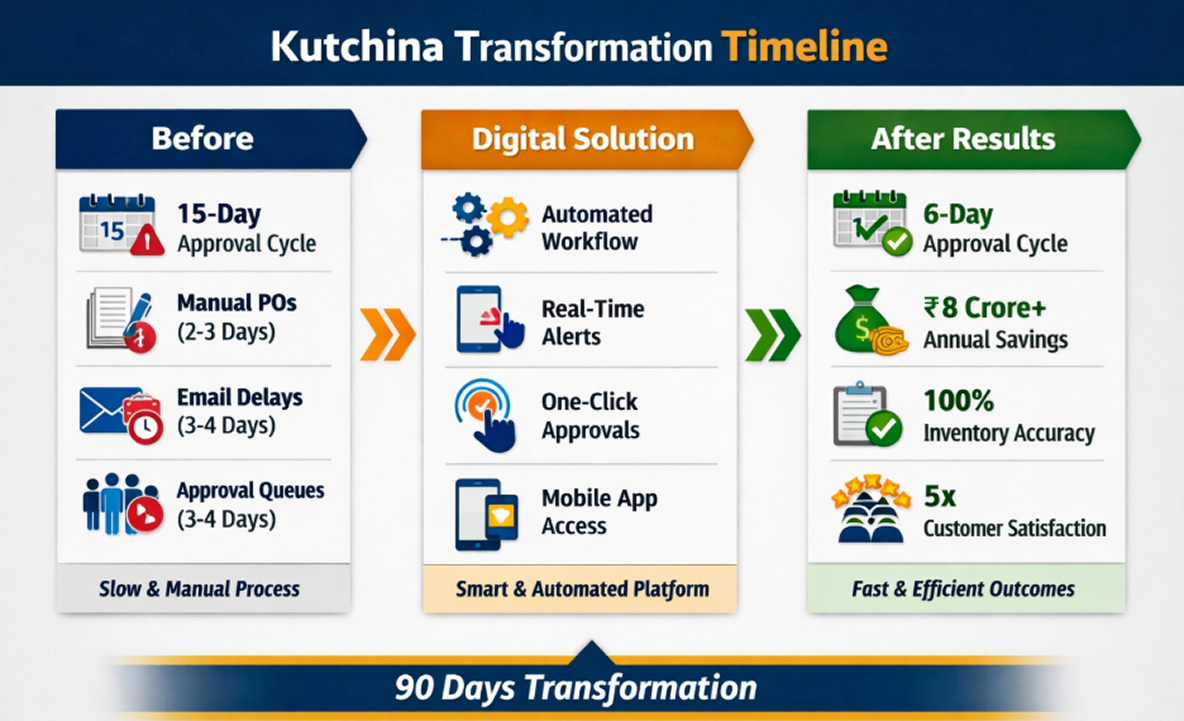
Kutchina, one of India’s largest appliance manufacturers, operates across eight business units, manages 200+ active vendors, and generates over ₹500 Crore annual revenue. Despite such scale, the company faced a major operational challenge! Procurement approvals trapped in manual, email‑driven workflows. Without real‑time visibility, senior management became a bottleneck, slowing decisions and impacting production timelines.
Before the Transformation:
The procurement process was cumbersome:
A 15‑day average approval cycle stretched across multiple manual steps.
PO generation alone took 2–3 days, followed by email routing delays of 3–4 days and approval queues adding another 3–4 days.
Any amendment cycles consumed 2–3 days more. The result was inefficiency, missed opportunities, and rising operational costs.
Solutions Implemented
Kutchina adopted an intelligent digital procurement platform designed to automate and accelerate every stage of the approval process. Key features included automated workflow routing, real‑time approval notifications, and escalation triggers for stuck purchase orders.
A one‑click approval interface simplified decision‑making, while a mobile app empowered managers to approve requests on the go. Together, these tools eliminated manual dependencies and created a transparent, responsive procurement ecosystem.
After Results
The transformation delivered measurable impact. Approval cycles dropped to 6 days, a 60% improvement over the previous baseline. Kutchina achieved ₹8 Crore+ in annual savings, 100% inventory accuracy, and a 5x improvement in customer satisfaction thanks to faster production and delivery. Implementation was completed in just 90 days, with zero disruption to ongoing operations.
Kutchina’s success demonstrates how Indian manufacturers can turn procurement from a bottleneck into a competitive advantage. By embracing digital automation, the company not only accelerated decision‑making but also strengthened resilience, efficiency, and customer trust—proving that transformation isn’t just about technology, it’s about redefining speed and success in modern manufacturing.
The Hidden Benefits of Faster Approvals
Benefit 1: Production Velocity
In manufacturing, time equals market share. A 9‑day faster procurement cycle translates directly into 9‑day faster production, giving manufacturers a 15% shorter time‑to‑market in the appliance industry. This speed enables companies to launch new products ahead of competitors, capturing early demand and setting the pace for innovation. Being first to market isn’t just an advantage—it’s a statement of leadership.
Benefit 2: Cash Flow Improvement
Faster procurement keeps inventory moving instead of sitting idle. Each day saved reduces storage costs by ₹50–100 per unit, which for a 10,000‑unit order means ₹45–90 lakhs in annual savings. With inventory in motion, cash flow improves, working capital is freed up, and manufacturers can reinvest in growth rather than warehousing.
Benefit 3: Inventory Control
Speed in approvals enables Just‑In‑Time manufacturing, ensuring materials arrive exactly when needed. This precision reduces inventory carrying costs by 15–25%, minimizes waste, and enhances production flexibility. Real‑time visibility allows procurement teams to align supply with demand seamlessly, turning inventory management into a strategic advantage.
Benefit 4: Vendor Relationships
Faster purchase orders mean vendors ship sooner and trust grows stronger. When manufacturers act decisively, suppliers reciprocate with priority service, better pricing, and favorable terms. Digital procurement fosters transparency and reliability, which are key ingredients for long‑term partnerships that drive mutual success.
Benefit 5: Customer Satisfaction
A 9‑day faster approval cycle directly improves delivery timelines. Manufacturers can fulfill urgent orders, reduce backlogs, and promise faster turnaround. The result is a clear competitive differentiation—customers choose the brand that delivers first. In a market where speed defines reputation, faster approvals translate into loyalty and repeat business.
Ultimately, digital procurement isn’t just about efficiency but t’s about unlocking velocity, cash flow, control, relationships, and customer delight. Manufacturers who act now will lead the next wave of India’s industrial transformation.
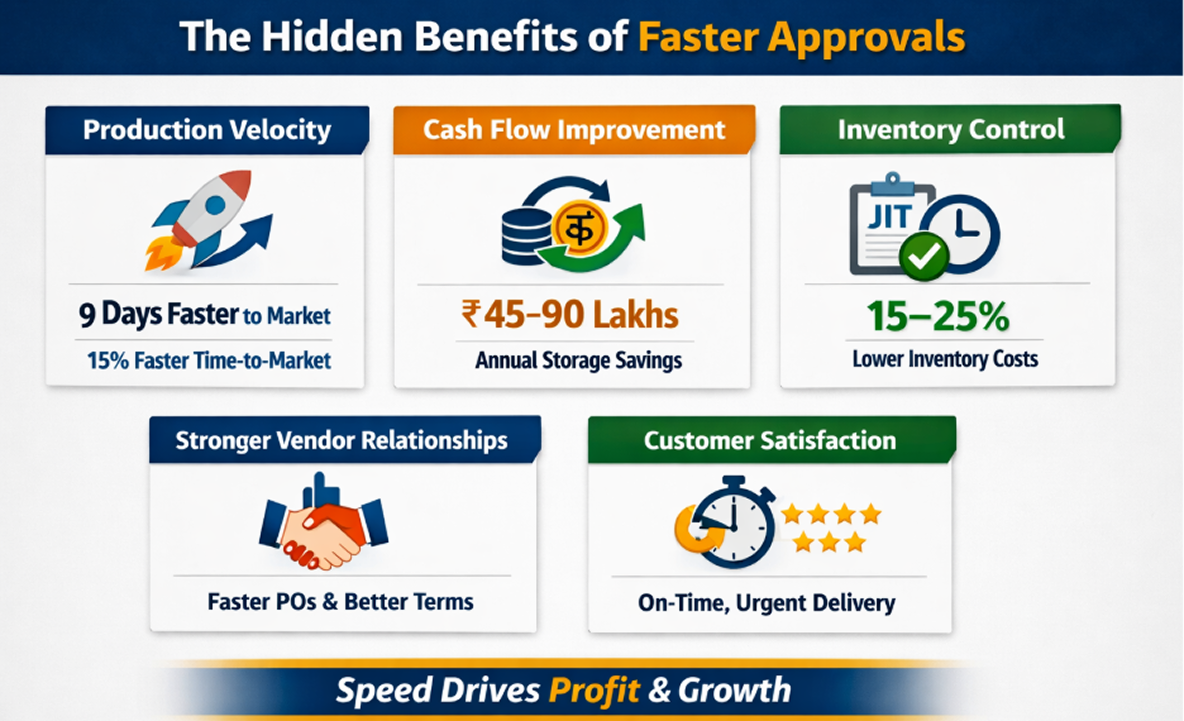
It highlights the five key benefits with clear icons and metrics:
- Production Velocity → 9 days faster to market, 15% faster time to market
- Cash Flow Improvement → ₹45–90 lakhs annual storage savings
- Inventory Control → 15–25% lower carrying costs with JIT manufacturing
- Vendor Relationships → Faster POs, stronger partnerships, better terms
- Customer Satisfaction → On‑time urgent delivery, 5× improvement in loyalty
The Numbers: ROI & Financial Impact
Implementation Cost
For mid‑market manufacturers, deploying a digital procurement platform typically costs ₹30–50 lakhs. This investment covers workflow automation, mobile approvals, and real‑time analytics without replacing enterprise ERP systems.
Annual Benefits
Once implemented, the financial impact is substantial. Manufacturers experience:
- Procurement cost reduction: ₹3–5 Crore through vendor consolidation and faster approvals.
- Inventory carrying cost savings: ₹1–2 Crore from improved visibility and reduced stockouts.
- Operational efficiency gains: ₹2–3 Crore via automation and reduced manual effort.
Total Annual Savings
Combined, these improvements deliver ₹6–10 Crore in annual savings, directly enhancing profitability and freeing capital for innovation. The platform pays for itself quickly, transforming procurement from a cost centre into a strategic growth engine.
Payback Period & ROI
The payback period is remarkably short—4–8 months, depending on order volume and vendor complexity. By Year 2, manufacturers typically achieve 1200–2000% annual ROI, driven by sustained efficiency, lower overheads, and faster production cycles.
Key Assumption
These figures assume the platform focuses solely on procurement automation, not full ERP replacement. The ROI stems from speed, transparency, and decision agility core levers of competitive manufacturing.
Digital transformation isn’t just an upgrade it’s a financial accelerator. Manufacturers who invest now will see measurable returns within months and long‑term gains that redefine operational excellence.
How Other Indian Manufacturers Are Following?
Adoption Rate & Timeline
Digital procurement is rapidly gaining traction across India’s manufacturing landscape. Nearly 23% of the top 100 Indian manufacturers have already implemented digital procurement platforms, signaling a decisive shift toward automation and transparency. Most implementations are completed within 90 days, proving that transformation doesn’t have to be disruptive—it can be swift and strategic.
Success Factors
The most successful adopters share common traits. Executive commitment, especially ownership by the CEO or COO, ensures alignment and momentum. Change management through structured training empowers procurement teams to adapt quickly. Seamless integration with existing ERP systems maintains continuity, while a quick wins mentality visible improvements within 30 days. Builds confidence and accelerates adoption.
Common Challenges & Solutions
Transitioning from legacy systems presents hurdles, but leading manufacturers are overcoming them with smart strategies:
Legacy system integration → solved through API‑first architecture for smooth data exchange.
User adoption → driven by mobile apps and hands‑on training that make digital tools intuitive.
Vendor compliance → strengthened via automated onboarding flows, ensuring suppliers align with new digital standards.
Indian manufacturers are proving that digital procurement isn’t just a technology upgrade, it’s a competitive necessity. Those embracing it now are setting new benchmarks for agility, cost efficiency, and customer responsiveness in the global manufacturing arena.
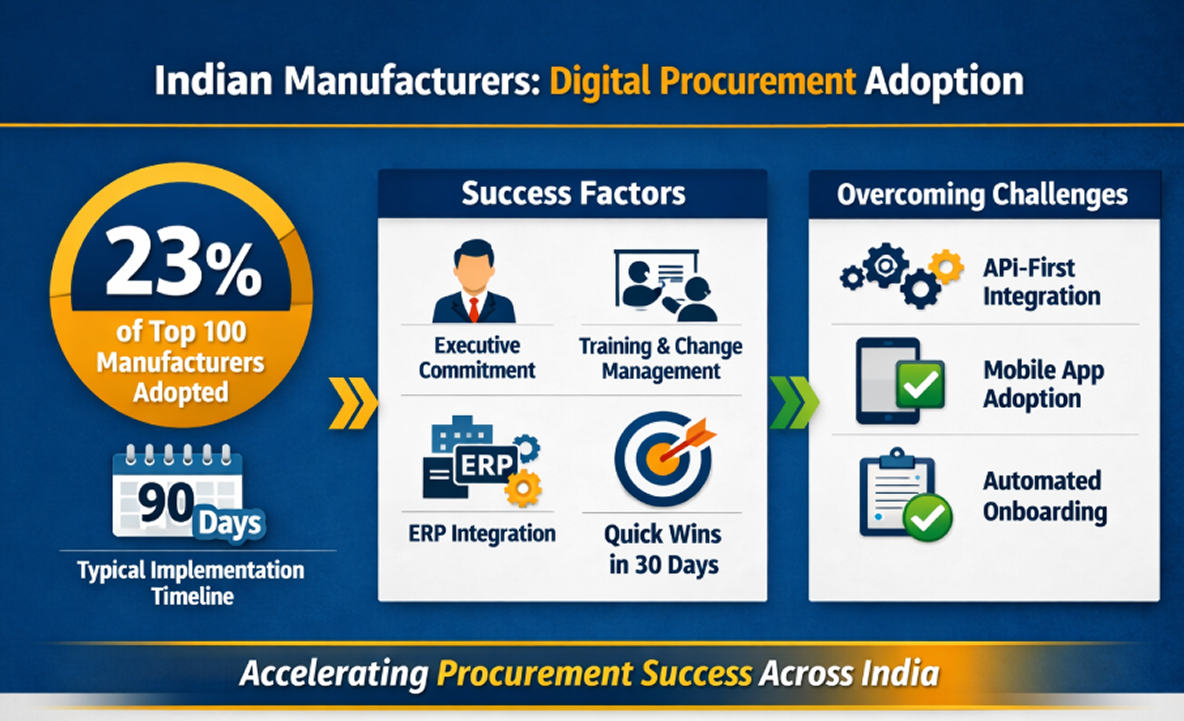
The above infographic highlights:
Adoption Rate & Timeline → 23% of top 100 Indian manufacturers already onboard, with a typical 90‑day implementation.
Success Factors → Executive commitment, training & change management, ERP integration, and quick wins within 30 days.
Overcoming Challenges → API‑first integration for legacy systems, mobile app adoption for ease of use, and automated vendor onboarding flows.
Bottom Line → Accelerating procurement success across India.
This infographic makes the adoption story instantly clear and compelling for executives, investors, or partners. It’s perfect for embedding in your whitepaper or presentation deck.
Phase 1 (Days 1–30): Assessment & Planning
Every transformation begins with clarity. In the first month, conduct a procurement process audit to understand current workflows. Map all approval nodes to visualize decision paths and identify bottlenecks in slowing progress. Calculate the existing approval cycle time and cost to establish a baseline for improvement. This phase builds the foundation for measurable change and executive alignment.
Phase 2 (Days 31–60): Platform Implementation
Next, configure digital approval workflows tailored to your organization’s structure. Integrate the platform with existing systems like ERP, vendor management, and inventory to ensure uninterrupted data flow. Train the procurement team to adopt new tools confidently. Begin with a soft launch involving a limited set of vendors to test functionality and gather feedback. This controlled rollout minimizes risk while demonstrating early wins.
Phase 3 (Days 61–90): Full Rollout & Optimization
Expand the platform to all vendors and optimize workflows based on insights from the pilot phase. Measure results against baseline metrics like approval time, cost savings, and vendor responsiveness. Celebrate quick wins to reinforce momentum and encourage continuous improvement. By day 90, your organization will have transitioned to a fully digital procurement ecosystem that delivers speed, transparency, and measurable ROI.
This roadmap ensures transformation happens systematically fast enough to show results yet structured enough to sustain long-term success.
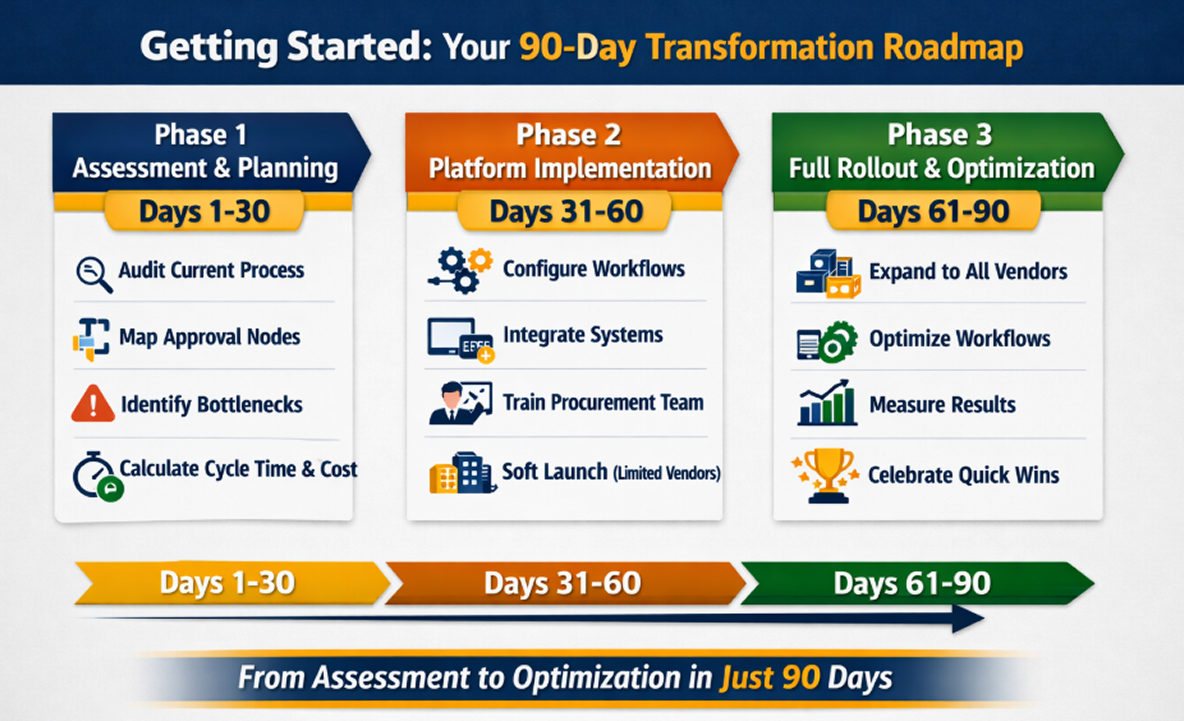
The Infographic Shows:
Phase 1 (Days 1–30: Assessment & Planning) → Audit current approval process, map nodes, identify bottlenecks, calculate cycle time & cost.
Phase 2 (Days 31–60: Platform Implementation) → Configure workflows, integrated systems, train procurement team, soft launch with limited vendors.
Phase 3 (Days 61–90: Full Rollout & Optimization) → Expand to all vendors, optimize workflows, measure results, celebrate quick wins.
The design uses a left‑to‑right timeline with distinct colors (yellow, orange, green) for each phase, icons for every milestone, and a bold banner at the bottom: “From Assessment to Optimization in Just 90 Days.”
The Time to Act Is Now
Do you think Kutchina’s 6‑day approval cycles are exceptional? Not! They have set a new standard. Across India, manufacturers are accelerating procurement to stay ahead. Your competitors are already moving, and your customers are expecting faster delivery.
Every 9 days faster approval translates into ₹6–10 Crore in annual savings. A direct boost to profitability and market share. The question isn’t if digital procurement is worth it; it’s when you’ll implement it.
Don’t let inefficiencies define your growth curve. Take the first step toward transformation today.
Explore the Kutchina Case Study to see real results. Use the Procurement Transformation ROI Calculator to estimate your potential savings. Schedule a 20 Minutes Approval Cycle Assessment and discover how quickly your organization can achieve the same speed and impact.
The future of manufacturing belongs to those who act fast.
Calculate your approval cycle cost and discover how much each day of delay costs your business and identify hidden inefficiencies.
Download: 90‑Day Digital Procurement Implementation Plan to avail a step‑by‑step roadmap to accelerate transformation without disrupting operations.
View Kutchina’s complete transformation! See how one manufacturer achieved 6‑day approval cycles and ₹8 Crore+ annual savings.