
logo

Scale Smarter with

Low Code No Code & Expert Engineering.

Accelerate application development using AI-assisted platforms while ensuring performance, security, and scalability.

Overview of AI-Assisted Low-Code Platforms

Replit has emerged as one of the popular collaborative development environments and an efficient low-code platform that integrates powerful AI coding capabilities. Its suite includes Ghostwriter, an AI assistant able to provide code completions, debugging suggestions, conversion between programming languages, and even autonomous code generation for complete applications.

icon
replit-logo

Replit: Pioneering AI-Enhanced Low-Code Development

icon

This platform stands for real-time, cloud-based development, broad-gauge/runtime support, and dynamic multiplayer features. Its AI coding assistant is integrated directly into the IDE, allowing both novice and professional developers to generate, refine, and run code immediately in the browser. Replit's deployment tools and community-driven templates expedite the creation of web apps, APIs, and automation scripts.

However, as the platform has unveiled more advanced code-generation features including multi-file project scaffolding and natural language app creation, several new limitations have surfaced.

AI-generated applications on Replit are frequently constrained by generic templates, insufficient context understanding, and spotty error handling, leading to brittle and insecure outputs.

Replit has emerged as one of the popular collaborative development environments and an efficient low-code platform that integrates powerful AI coding capabilities. Its suite includes Ghostwriter, an AI assistant able to provide code completions, debugging suggestions, conversion between programming languages, and even autonomous code generation for complete applications.

icon

Lovable: Visual AI for Cross-Platform Application Development

icon
icon

Lovable: Visual AI for Cross-Platform Application Development

icon

Lovable positions itself as an all-in-one AI builder, empowering users to create sophisticated web and mobile applications visually, often without writing a single line of code. Its platform features drag-and-drop functionality, automated database generation, and UI/UX recommendations driven by generative AI.

Lovable AI App Builder, users input their app ideas in natural language, and the system generates working frontends and business logic. The resulting applications can integrate with third-party services, leverage AI-driven design patterns, and deploy to the cloud in just a few clicks. Lovable's focus on no-code/low-code paradigm means speed is prioritized over deep customization.

Nevertheless, Lovable applications commonly exhibit design rigidity, limited extensibility for custom workflows, and shallow API integration support. These make the platform difficult for advanced users to implement bespoke business logic or adapt interfaces for complex UX scenarios.

icon
icon

base44: Automating App Development with AI and No-Code

icon

The platform base44 is marketed as an advanced AI-powered platform for quickly generating, customizing, and launching robust applications. Targeted at business users and startups, base44 offers visual workflows, AI-generated data schema, and point-and-click integrations with external APIs and databases.

Unlike many competitors, base44 emphasizes “enterprise-grade” app scaffolding, deeper integration options (including legacy systems), and more flexible user authentication modules. Still, generating application is governed by the limits of what base44's AI and configurators can infer from user prompts. This most often results in generic or over-simplified logic, security oversights, and integration stumbles when requirements exceed built-in templates or demand novel interoperability.

Platform Ease of Use Flexibility/Customization Scalability Developer Involvement Needed API Integration Quality Security Controls UX/UI Polish
Replit High (intuitive IDE, rapid prototyping) Moderate (AI suggestions but limited for complex apps) Moderate (good for prototypes, less so for high-scale) High (manual debugging, security, perf tuning) Basic to Intermediate Weak by default, must be audited Basic templates; UI flexibility limited
Lovable Very High (drag-and-drop, no-code AI builder) Low-Moderate Very High (advanced features require handoff) Limited to mainstream APIs Limited to mainstream APIs Weak (compliance gaps, opaque defaults) Standardized; poor for advanced brands
base44 High (business-user-friendly, AI configuration) Moderate (some custom logic, more API depth) Moderate (claims enterprise support, limited in practice) High (integration, security, scaling fixes) Intermediate (good API library) Must be hardened manually Template-driven; moderate flexibility

Why Do Organizations Choose Low-Code / AI-Assisted Platforms?

Advantages of AI-Generated Development Platforms

image

Speed to Market

One of the major advantages of building MVPs and prototypes is choosing AI-assisted platforms. AI-generated development platforms or the low code platforms dramatically accelerate time to market by transforming ideas into functional applications within days. Automated code generation, prebuilt components, and intelligent workflows help teams in rapid prototyping, iterating, and launching products with minimal manual effort. The entire process allows businesses to validate ideas faster and respond quickly to market demands.

AI-Assisted Productivity

Low code no code platforms ensure AI-Assisted productivity and is one of the biggest advantages of AI-generated development platforms. By translating natural language prompts into functional code, automating repetitive tasks, and accelerating prototyping, these platforms significantly reduce development effort and time. Teams can focus more on problem-solving and innovation rather than boilerplate coding, enabling faster iterations, quicker feedback cycles, and improved overall productivity. These platforms generate functional code from natural language prompts and visual flows.

Visual Development

It is known to all that most of the AI-generated development platforms leverage visual interfaces. For example, drag-and-drop components, workflow builders, and real-time previews are to name a few. It also simplifies application creation and reduces complexity. This approach accelerates development, minimizes manual coding errors, and enables faster collaboration between technical and non-technical teams. This makes it easier to translate ideas into functional applications with utmost clarity and speed.

Cost Efficiency (Early Stages)

Most organizations are opting for AI-generated development platforms because of lesser initial development cost and reduced dependency of having huge teams. It also minimizes the lengthy development cycles along with upfront infrastructure investments. With automated code generation, prebuilt components, and managed environments, organizations can rapidly build and validate ideas at a fraction of traditional development costs. These advantages make these platforms ideal for MVPs, pilots, and proof-of-concept initiatives.

Rapid Iteration

AI-generated development platforms enable teams to move from idea to implementation at unprecedented speed. By instantly generating code, UI components, and workflows from prompts or visual inputs, they significantly reduce development cycles and allow quick experimentation, faster feedback, and continuous refinement. All these make them ideal for prototyping, MVPs, rapid iteration and innovation-driven projects.

Where AI-Generated & Low-Code Platforms Fall Short

It is true that AI-generated and low-code platforms expedite the projects and meet deadlines, but sometimes these also fall short. These platforms often struggle with production-grade demands such as clean architecture, scalability, security, and long-term maintainability. The low code platforms also have limited control over system design, inconsistent generated code, restricted customization, and challenges around compliance and integrations. There are cases that create technical debt as the applications grow. making expert engineering oversight essential beyond early-stage development.

Limitations of Platforms like Replit, Lovable & Base44

Platforms such as Replit, Lovable, and Base44 are excellent for rapid prototyping and early-stage development, but they often fall short when applications move toward production scale.

This section discusses the common limitations like;

image
icon Tightly Coupled Architectures
icon Inconsistent AI-generated Code,
icon Limited Control Over Security and Compliance
icon Constrained Scalability
icon Dependence on Platform-Specific Abstractions
icon Long-term Maintenance and Enterprise Adoption
icon Challenging without Additional Engineering Effort.
icon Back-up DATA Recovery (DATA Center Related)

Architectural Constraints

Platforms like Replit, Lovable, and Base44 often impose rigid architectural abstractions that limit how applications are structured and evolved. AI-generated code typically results in tightly coupled components with minimal separation of concerns, making it difficult to implement domain-driven design, modular services, or clean layering. As applications grow, these constraints hinder scalability, complicate refactoring, and restrict the ability to adapt architectures to complex business or compliance requirements.

Scalability & Performance Issues

Most of the platforms like Replit, Lovable, and Base44 struggle under high concurrency, complex workflows, or large datasets. These are optimized for rapid development but often struggle under production-scale workloads. The platforms have limited control over infrastructure, inefficient AI-generated code paths, and constraints around concurrency. Caching, and resource allocation can lead to latency, bottlenecks, and degraded performance as user demand grows. Hence, these are less suitable for high-traffic or compute-intensive applications without significant architectural rework.

Security & Compliance Gaps

Replit, Lovable, and Base44 accelerate development but have limited control over infrastructure, logging, access management, and data governance can make it challenging to meet strict compliance requirements such as SOC 2, HIPAA, GDPR, ISO 27001, and PCI-DSS. These limitations make platforms less suitable for regulated or mission-critical systems without significant architectural and security enhancements.

Limited Extensibility

Custom integrations, advanced APIs, and legacy system connectivity can be restrictive with low code no code AI-generated platforms. Replit, Lovable, and Base44 often rely on predefined workflows, templates, and proprietary abstractions, which can limit extensibility as application needs growth. Implementing complex business logic, advanced integrations, custom APIs, or specialized infrastructure configurations may be constrained and can make it difficult to adapt to these platforms for highly customized, evolving, or enterprise-grade use cases.

Maintainability Challenges

Generated code is often inconsistent, difficult to refactor, and poorly documented. Applications built on platforms such as Replit, Lovable, and Base44 often face maintainability issues as they evolve beyond initial prototypes. AI-generated and platform-abstracted code can be inconsistent, tightly coupled, and difficult to refactor or extend, making debugging, upgrades, and team onboarding more complex over time. This accumulation of technical debt can slow innovation and increase long-term maintenance costs without deliberate engineering intervention.

Vendor Lock-In Risks

Proprietary frameworks and abstractions make platform migration costly. Applications built on the Low Code No Code platforms such as Replit, Lovable, and Base44 often face maintainability issues as they evolve beyond initial prototypes. AI-generated and platform abstracted code can be inconsistent, tightly coupled, and difficult to refactor or extend, making debugging, upgrades, and team onboarding more complex over time. This accumulation of technical debt can slow innovation and increase long-term maintenance costs without deliberate engineering intervention.

The Reality: Low-Code Is Not No Engineering

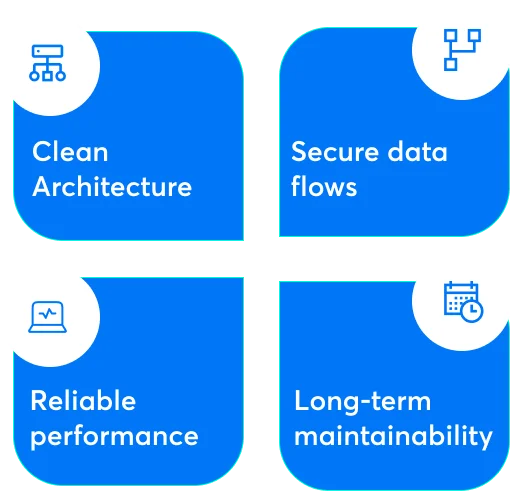
Low-code and AI-assisted platforms are powerful accelerators, but they do not replace core engineering principles. Designing scalable architectures, ensuring security and compliance, managing performance, and maintaining code quality still require experienced engineers, especially as applications grow beyond prototypes into mission-critical systems.

As applications grow, expert intervention becomes critical to ensure:

image

Successful organizations adopt the hybrid approach along with advanced infrastructure to get the robust platform.

Our Hybrid Low-Code Enablement Approach

Low Code Hybrid = Speed from AI & Strength from Engineering.

We blend the speed of low-code platforms with the robustness of traditional engineering. Our approach accelerates delivery using visual and AI-assisted tools while ensuring scalability, security, compliance, and long-term maintainability.

image
What We Do:

Low-Code Application Audit

A low-code application audit evaluates architecture, security, performance, and maintainability beyond what visual tools expose. It helps identify hidden technical debt, compliance gaps, and scalability risks before they impact business-critical operations.

Production-Grade Refactoring

Production-grade refactoring focuses on improving code structure, performance, and scalability without disrupting live systems. It emphasizes backward compatibility, automated testing, observability, and incremental changes to ensure reliability while evolving the architecture.

Security & Compliance Hardening

As applications scale, built-in security controls of low-code and AI-generated platforms are often insufficient for enterprise needs. Strong hardening requires custom access controls, secure data handling, audit logging, and adherence to compliance standards like SOC 2, HIPAA, GDPR, ISO and PCI-DSS through deliberate engineering practices.

Advanced Integrations

Advanced integrations help in enabling connectivity with enterprise systems, third-party APIs, data warehouses, and cloud services. While these platforms simplify integration through connectors and workflows. Apart from these complex scenarios, such as real-time data sync, custom authentication, and event-driven architectures still require expert engineering support.

Performance & Scalability Optimization

While low-code/no-code platforms help in speeding delivery, optimizing performance and scalability often requires custom engineering. As user loads increase, teams must fine-tune data models, integrations, and infrastructure beyond visual abstractions to ensure reliable, high-performing systems.

When Low-Code Works Best (Use-Case Clarity)

Low-code platforms work best for rapid prototyping, internal tools, MVPs, and workflow-driven applications where speed, standardization, and time-to-market matter more than deep customization. They are ideal when business logic is relatively straight forward, scalability requirements are predictable, and teams want to empower non-developers while still being supported by engineering oversight.

Ideal For Not So Ideal For (Without Expert Support)
MVPs & Proofs of Concept Financial systems
Internal tools Healthcare platforms
Workflow automation Large-scale SaaS products
Early-stage startups Mission-critical enterprise applications
Why CodeLogicX Low Code No Code Solutions?

CodeLogicX helps you move fast without cutting corners. We combine the speed of low-code and AI-generated platforms with strong engineering, security, and scalability expertise. These transform quick builds into reliable, production-ready solutions that grow with your business.

image

Why will you trust us?

icon Expertise in both AI-assisted & traditional engineering
icon Apt Auditing
icon Architecture-first mindset
icon Security and compliance-led delivery
icon Proven modernization experience
icon Platform-agnostic approach (no vendor bias)
icon Security and Compliance Hardening
logo

Is Your Low-Code App Ready for Real-World Scale? Real-World Scale? If not, then we can help you turn your vision into reality. Ready to build faster without compromising quality?

Let CodeLogicX help you turn low-code speed into enterprise-grade solutions.

Low-code and no-code platforms unlock rapid innovation—but lasting success comes from the right balance of automation and engineering. With CodeLogicX, you get agility, scalability, and security aligned to your business goals.

Please enter name.
Please select country
Please enter a message
Solve: +