Objective
The objective of this blog is to explain how AI-driven customer intelligence helps organizations transform fragmented, high-volume customer data into actionable business insights. It explores how Artificial Intelligence, machine learning, predictive analytics, and real-time data processing can improve customer segmentation, personalization, retention, forecasting, and revenue generation.
The blog also highlights the importance of a strong data foundation, responsible AI, integration, and scalable architecture for organizations looking to move from data collection to intelligent decision-making.
From Data Overload to Customer Intelligence
Did you know that every customer interaction generates data?
A website visit, mobile-app session, purchase, support ticket, email interaction, social engagement, search query, loyalty activity, and even abandoned cart can contribute to an increasingly detailed picture of customer behavior.
The challenge is no longer simply collecting data. The real challenge is understanding it.
Organizations often have customer information distributed across CRM platforms, e-commerce systems, marketing automation tools, customer-support platforms, mobile applications, data warehouses, and third-party services. The result is a fragmented data landscape where valuable insights remain hidden across disconnected systems. This is where AI-driven customer intelligence becomes transformative.
Instead of simply reporting what happened, AI can help organizations identify why it happened, what is likely to happen next, and what action could create the greatest business impact.
The objective is to move from:
What Is AI-Driven Customer Intelligence?
AI-driven customer intelligence goes far beyond traditional reporting by combining artificial intelligence, machine learning, predictive analytics, natural language processing (NLP), automation, and customer data platforms (CDPs) to uncover the reasons behind customer actions and predict future behavior.
While traditional analytics might simply report that customer purchases have declined by 15% over the last quarter, AI-driven systems can reveal that 42% of those customers reduced spending due to personalized offers from competitors, 28% experienced dissatisfaction with delivery times, and nearly 35% are at a high risk of churning within the next 60 days.
Additionally, AI models can identify that customers who engage with personalized recommendations are up to 3 times more likely to make repeat purchases, while predictive analytics may forecast a 20–25% increase in retention rates if targeted interventions are implemented. This deeper, data-driven intelligence enables businesses to move beyond understanding what happened and focus on why it happened and what actions should be taken next to improve customer loyalty and revenue growth.
AI-driven intelligence can go further by identifying patterns such as:
- Identify declining customer segments
- Understand the products or experiences contributing to the decline
- Identify customers at risk of churn
- Determine customers most likely to respond to a promotion
- Evaluate the channels that generate the strongest engagement
- Recommend the next-best action
These differences are significant. Customer intelligence helps organizations act on the present and prepare for the future.
Why Is Traditional Customer Analytics No Longer Enough?
Traditional customer analytics is no longer enough because it primarily focuses on understanding what happened in the past rather than predicting what is likely to happen next. While historical reports and dashboards can reveal trends, customer expectations, behaviors, and market conditions now change much faster than traditional analytics can capture.
Modern organizations need advanced, AI-driven analytics that go beyond descriptive insights to identify customers at risk of churn, predict future purchasing behavior, recommend the next-best action, and personalize engagement in real time. By combining customer data, behavioral signals, and predictive models, businesses can shift from reactive decision-making to proactive customer management, improving retention, loyalty, and overall customer lifetime value.
They answer questions such as:
- How many customers purchased?
- What was the revenue last month?
- Which products performed best?
- How many customers churned?
AI-driven intelligence introduces more dynamic questions:
- Who is showing the earliest signals of customer attrition before they churn?
- What underlying factors are causing engagement to fade over time?
- Where does the greatest untapped customer lifetime value reside?
- How can every customer be matched with the offer they are most likely to value?
- What customer touchpoint has the highest probability of driving conversion?
This shift from descriptive analytics to predictive and prescriptive intelligence enables organizations to make faster and more targeted decisions.
Where Customer Data Chaos Comes From?
Customer data chaos often stems from the rapid growth of data across multiple systems, departments, and channels without a unified management strategy. Organizations collect customer information from websites, mobile apps, CRM platforms, social media, support centers, and third-party sources, creating data silos that prevent a single, accurate view of the customer.
Over time, inconsistent data entry practices, duplicate records, outdated information, and a lack of governance further compound the problem. Mergers, legacy systems, and disconnected technologies can also add complexity, making it difficult to maintain data quality and consistency. As a result, businesses struggle with inaccurate insights, inefficient operations, and poor customer experiences, highlighting the need for centralized data management and robust governance practices.
A typical organization may have:
CRM Data
Customer profiles, account information, sales activities, and relationship history.
Transactional Data
Purchases, subscriptions, payments, returns, and order history.
Digital Behavior
Website clicks, searches, page views, app activity, and abandoned sessions.
Marketing Data
Campaign interactions, email engagement, advertisements, and conversion activities.
Support Data
Tickets, complaints, conversations, satisfaction scores, and resolution history.
Social & Engagement Data
Reviews, comments, social interactions, and brand sentiment.
The challenge is connecting these datasets while maintaining data quality, consistency, identity resolution, privacy, and real-time availability.
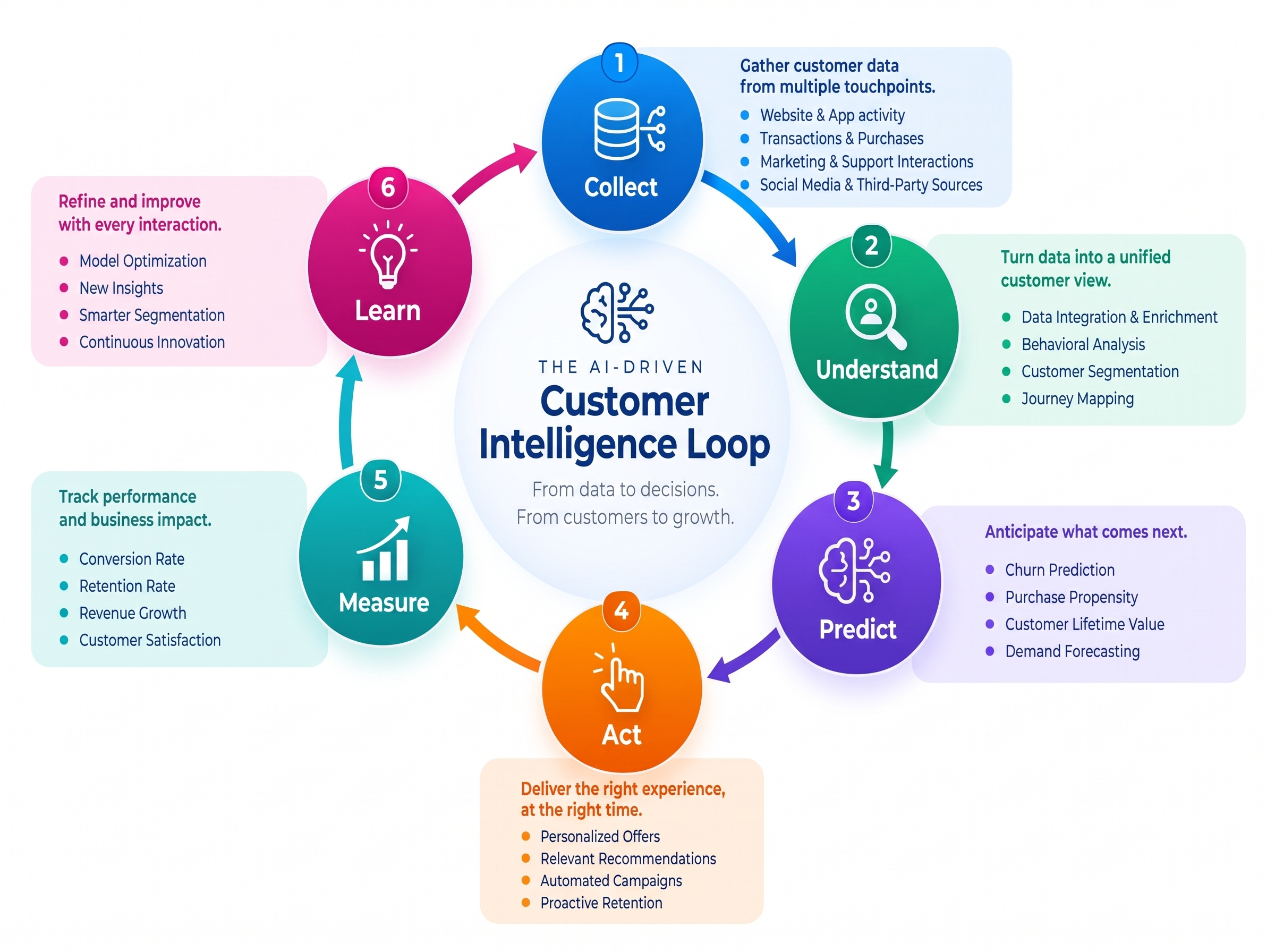
How AI Turns Fragmented Data into Actionable Intelligence?
AI transforms fragmented data into actionable intelligence by collecting information from multiple disconnected sources, such as databases, emails, customer interactions, sensors, and business applications, and then analyzing it to uncover patterns, trends, and meaningful insights. Using technologies like machine learning, natural language processing, and predictive analytics, AI can identify relationships that might be overlooked through manual analysis, eliminate data silos, and provide a unified view of operations.
This enables organizations to move beyond simply gathering data and instead make faster, more informed decisions, anticipate future outcomes, optimize processes, and respond proactively to emerging opportunities or risks. In essence, AI converts scattered, unstructured, and complex data into clear, relevant, and actionable intelligence that drives business value.
1 . Data Consolidation
Data from multiple sources is integrated into a unified customer view.
2 . Data Enrichment
AI can identify relationships and behavioral signals that may not be obvious from individual datasets.
3 . Pattern Detection
Machine learning models identify recurring behaviors, anomalies, and correlations.
4 . Prediction
AI models estimate potential future outcomes such as churn, conversion, demand, or customer lifetime value.
5 . Recommendation
The system can recommend actions based on customer context.
6 . Continuous Learning
As new customer interactions occur, models can be retrained or updated to improve future predictions.
This creates a continuous intelligence loop:
Key Components of an AI-Driven Customer Intelligence System
Customer Data Integration
The foundation is a unified data ecosystem capable of connecting CRM, ERP, e-commerce, marketing, support, analytics, and external data sources. Without reliable integration, AI models are only as effective as the fragmented data they receive.
AI-Powered Data Processing
AI and machine learning can help classify, enrich, clean, and organize large volumes of structured and unstructured customer information.
Natural language processing can also extract insights from:
Customer Segmentation
Instead of relying solely on demographic segments, AI can create behavioral segments based on:
This allows organizations to move toward dynamic customer segmentation.
Predictive Analytics
Predictive models can help identify potential outcomes before they occur.
Common applications include:
Personalization Engines
AI can use customer context to personalize:
The goal is to make interactions more relevant rather than simply increasing the volume of communication.
Real-Time Decisioning
Customer intelligence becomes significantly more valuable when insights can be generated during customer interaction.
For example:
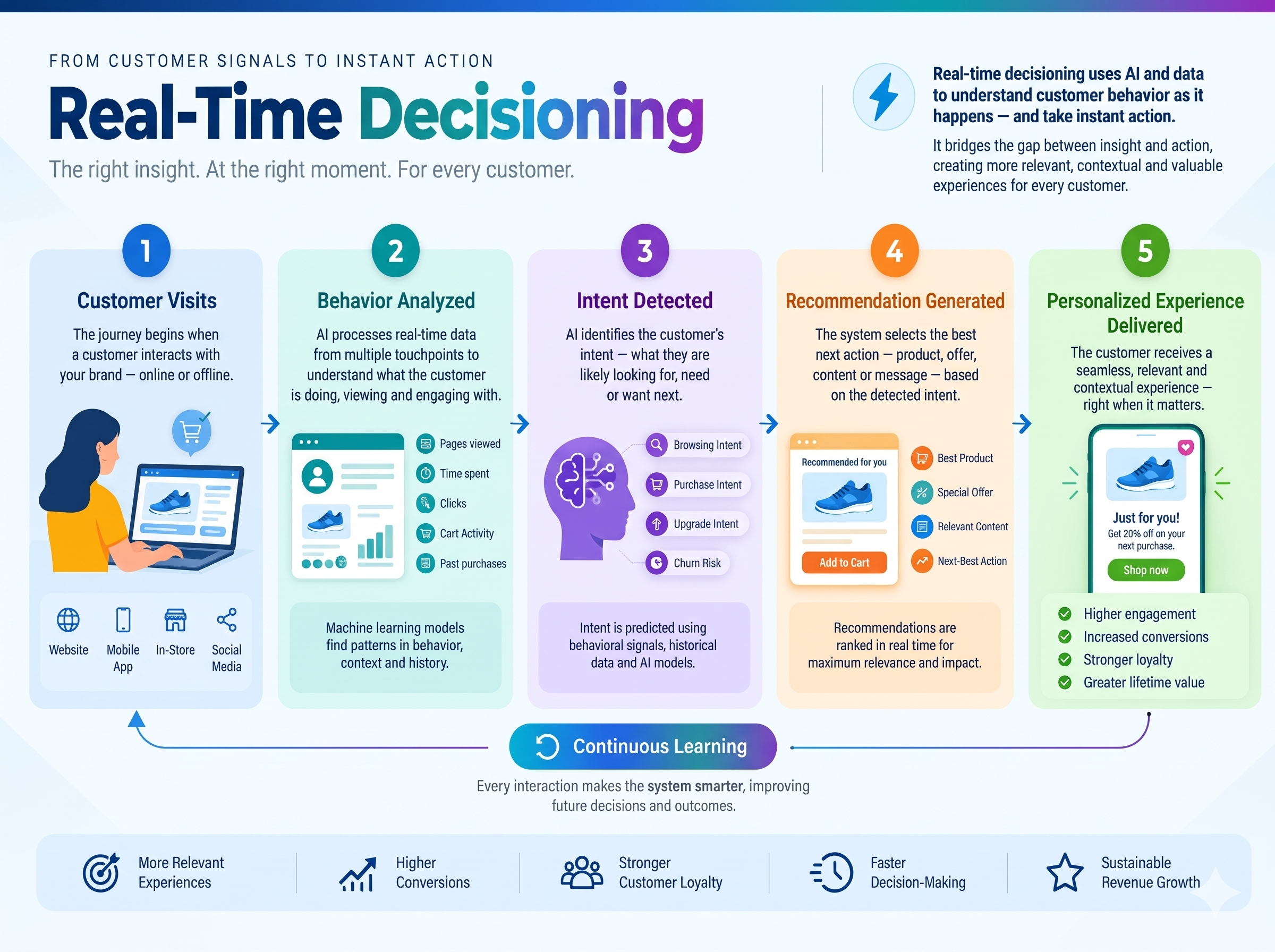
This reduces the gap between insight and action.
Customer Journey Intelligence
AI can analyze customer journeys across multiple touchpoints to identify:
- Opportunities for engagement
This allows organizations to optimize the complete customer experience rather than individual channels.
Turning Customer Intelligence into Revenue Precision
It is always better to create strategic business decisions. AI-driven customer intelligence can support revenue generation in several areas.
The ultimate objective is not simply to generate more data insights, but to transform those insights into smarter, faster, and more profitable business decisions. AI-driven customer intelligence enables organizations to move beyond historical reporting and gain a deeper understanding of customer behaviors, preferences, purchase patterns, and intent signals in real time. By analyzing vast amounts of customer data, AI helps identify high-value opportunities, predict future demand, personalize engagement strategies, and optimize resource allocation.
This intelligence empowers sales, marketing, and customer success teams to focus on the right customers with the right offers at the right time, ultimately improving conversion rates, increasing customer lifetime value, reducing churn, and driving sustainable revenue growth. In this way, customer intelligence becomes a strategic asset that helps organizations achieve greater revenue precision and maximize business performance.
Smarter Customer Acquisition
Predict which prospects are more likely to convert and prioritize sales and marketing resources accordingly.
Higher Conversion Rates
Identify customer intent and deliver relevant experiences at the right moment.
Improved Cross-Selling
Identify products or services that complement existing customer behavior.
Better Upselling
Predict when customers may be ready for a higher-value product or service.
Reduced Churn
Identify customers showing behavioral signals associated with disengagement and trigger appropriate retention strategies.
Increased Customer Lifetime Value
Understand which customers have greater long-term potential and develop targeted engagement strategies.
More Efficient Marketing
Optimize campaigns based on predicted customer response rather than treating every customer equally.
Key Use Cases for Different Industries
Retail & E-Commerce
AI can power:
- Personalized recommendations
- Dynamic customer segmentation
- Cart abandonment prediction
Banking & FinTech
Applications include:
- Customer lifetime value modeling
- Personalized financial products
- Customer journey optimization
Healthcare
Customer intelligence can support:
- Appointment behavior analysis
- Personalized communication
- Service utilization insights
- Patient journey optimization
Healthcare applications require particularly strong privacy, security, and governance controls when sensitive information is involved.
Travel & Hospitality
AI can analyze:
SaaS & Technology
AI-driven intelligence can help identify:
- Product adoption patterns
Benefits of AI-Driven Customer Intelligence
Organizations implementing customer intelligence strategically can pursue several benefits:
More Precise Targeting
Understand which customers require which message or offer.
Faster Decision-Making
Move from static reports toward real-time intelligence.
Revenue Optimization
Identify opportunities for conversion, retention, upselling, and cross-selling.
Better Customer Experiences
Deliver more relevant and contextual interactions.
Deeper Customer Understanding
Connect behavioral signals across multiple channels.
Improved Marketing Efficiency
Allocate resources toward customers and campaigns with stronger predicted potential.
Continuous Optimization
Use new data to continuously refine models and strategies.
Challenges and Risks to Consider
AI-driven customer intelligence is not simply an AI implementation exercise. It requires organizations to rethink how customer data is collected, managed, and transformed into actionable insights. Beyond deploying advanced technologies, businesses must address challenges such as data quality, privacy and security concerns, integration of data across multiple channels, and the need for skilled talent to interpret AI-driven outputs.
Organizations must also ensure transparency, ethical use of customer information, and alignment between business objectives and AI strategies. Successfully overcoming these challenges enables companies to build a more accurate understanding of customer needs, deliver personalized experiences, and create sustainable competitive advantages.
Data Quality
Poor-quality or incomplete data can produce unreliable insights.
Data Silos
Disconnected systems can prevent organizations from creating a unified customer profile.
Privacy
Customer intelligence requires careful handling of personal and potentially sensitive information.
Model Bias
AI models can reproduce biases present in training data.
Explainability
Business users may need to understand why an AI system produced a particular recommendation or prediction.
Integration Complexity
Connecting legacy systems, SaaS platforms, APIs, data warehouses, and AI services can become technically complex.
Infrastructure Costs
Large-scale data processing and AI workloads require careful architecture and cost management.
Governance
Organizations need clear policies around data access, model management, monitoring, and responsible AI usage.
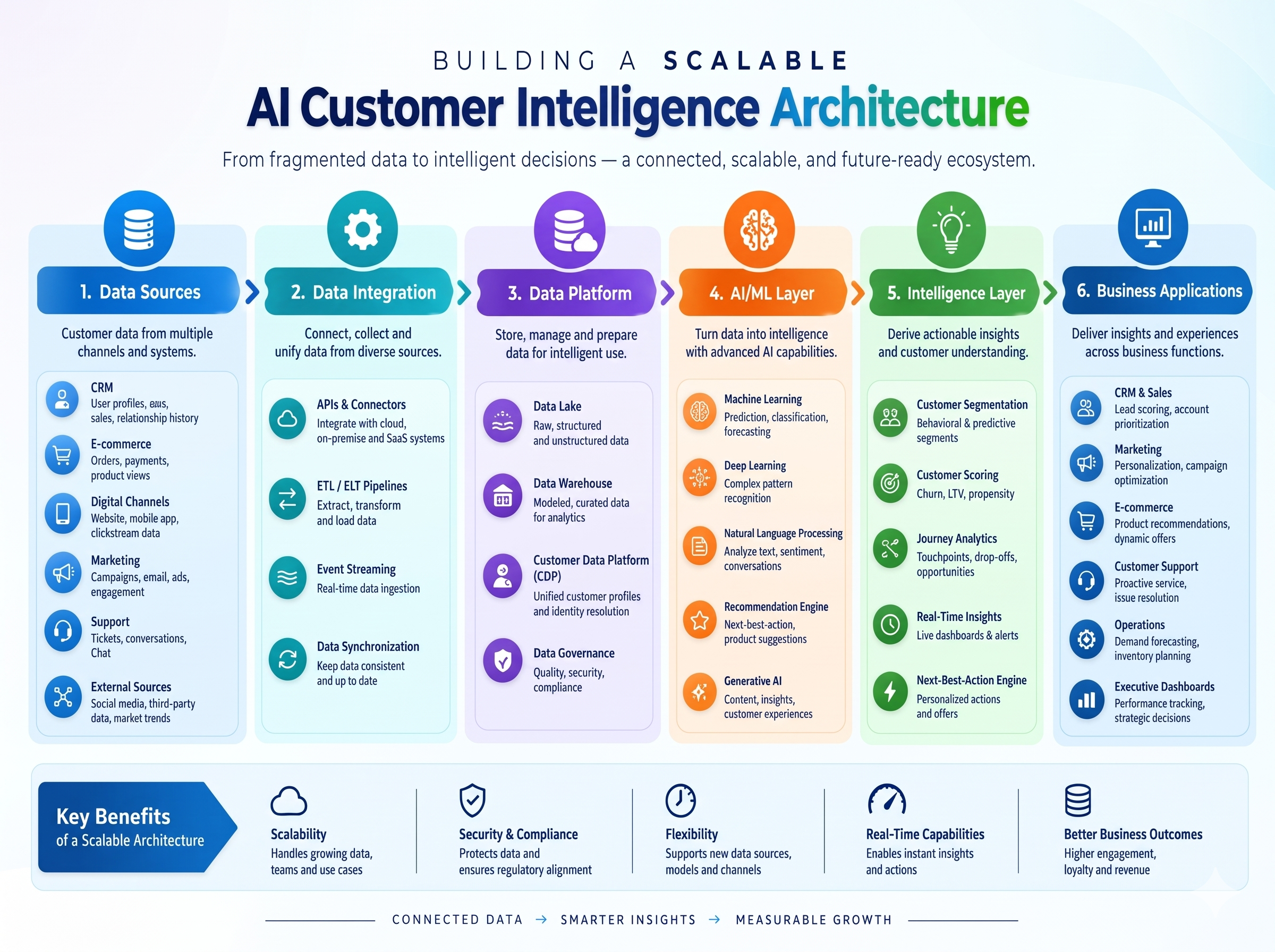
Building a Scalable AI Customer Intelligence Architecture
A scalable architecture should typically include several layers:
Data Sources → Data Integration → Data Platform → AI/ML Layer → Intelligence Layer → Business Applications
Data Sources
CRM, ERP, websites, mobile applications, e-commerce, support systems, marketing platforms, and third-party APIs.
Integration Layer
APIs, event streaming, ETL/ELT pipelines, and data synchronization mechanisms.
Data Platform
Data lakes, warehouses, customer data platforms, and analytical stores.
AI/ML Layer
Machine learning models, recommendation engines, predictive analytics, NLP, and generative AI capabilities.
Intelligence Layer
Customer scoring, segmentation, propensity models, next-best-action engines, and customer journey analytics.
Business Applications
Dashboards, CRM systems, marketing automation, personalization engines, sales tools, and customer-facing applications. The architecture should remain modular, observable, secure, and scalable so that organizations can introduce new models and data sources without rebuilding the entire platform.
Best Practices for Successful Implementation
Start With a Business Problem
Don’t begin with: “Where can we use AI?”
Start with: “Which customer or revenue problem are we trying to solve?”
Build a Unified Customer View
Create consistent customer identities across channels and systems.
Prioritize High-Value Use Cases
Begin with measurable use cases such as churn prediction, lead scoring, recommendation, or customer segmentation.
Establish Data Governance
Define:
Keep Humans in the Loop
AI recommendations should support business teams rather than blindly replace human judgment, particularly for high-impact decisions.
Monitor Models Continuously
AI models can degrade as customer behavior changes. Monitor:
Measure Business Outcomes
Don’t evaluate an AI system solely on technical accuracy.
Measure whether it contributes to:
Measuring the Business Impact
A successful customer intelligence program should connect technical metrics with business KPIs.
| Intelligence Area | Example KPI |
| Personalization | Conversion rate |
| Churn Prediction | Retention rate |
| Recommendation Engine | Average order value |
| Lead Scoring | Lead-to-customer conversion |
| Customer Segmentation | Campaign response rate |
| Customer Journey Analytics | Journey conversion |
| Customer Lifetime Value | CLV growth |
| Marketing Intelligence | Customer acquisition efficiency |
The important principle is simple:
AI should be measured by business impact—not by model complexity alone.
The Future of AI-Powered Customer Intelligence
Customer intelligence is moving toward increasingly autonomous and real-time systems.
Future architectures are likely to combine:
- Real-time event processing
- Conversational interfaces
Instead of waiting for analysts to interpret dashboards, organizations will increasingly have systems that can detect signals, explain patterns, recommend actions, and assist teams in executing those actions.
The competitive advantage will therefore shift from having more data to turning data into useful decisions faster and more responsibly.
Conclusion
Data alone does not create competitive advantages. Intelligence does.
Organizations today have access to enormous volumes of customer information, but fragmented systems, disconnected channels, and inconsistent data can prevent that information from becoming actionable.
AI-driven customer intelligence provides a path forward by connecting data, identifying behavioral patterns, predicting future outcomes, and helping businesses determine the next best action.
The journey is not simply about implementing an AI model. It requires a combination of strong data foundations, scalable architecture, responsible AI, integration, governance, and continuous optimization.
When these elements work together, organizations can move from data chaos to customer clarity—and from broad targeting to revenue precision.
The future of customer intelligence isn’t about collecting more data. It’s about making every meaningful customer signal count.