Every enterprise now has an AI story. Adoption has moved faster than almost any enterprise technology in recent memory McKinsey’s 2025 global survey found that 88% of organizations now use AI in at least one business function, up from 78% a year earlier. Knowledge workers use large language models daily. Boards ask about AI strategy in nearly every quarterly review.
And yet business impact has not kept pace with adoption. The same McKinsey survey found that only 39% of organizations report any enterprise-level EBIT impact from AI and for most of those, the impact is under 5%.
MIT researchers, studying the same phenomenon from a different angle, gave it a name: the “GenAI Divide” a split between the small number of organizations translating AI pilots into measurable P&L impact, and the much larger number left with impressive demos and no bottom-line change.
This is the paradox at the center of enterprise AI in 2026:
It has never been easier to start a pilot, and it has rarely been harder to scale one into something the business depends on. Understanding why is the first step to fixing it.
The Numbers Behind the Narrative
Every major research organization tracking enterprise AI in 2025 arrived at a version of the same finding using different methods, different samples, and different definitions of “failure”:
The figures aren’t strictly interchangeable with RAND and Gartner measure projects, S&P Global measures companies, and McKinsey measures EBIT impact, but the direction is consistent across five independent methodologies.
It’s also expensive to get in touch. IDC projects worldwide AI spending will more than double to $632 billion by 2028. At an 80%+ failure rate, a meaningful share of that spend is being invested in initiatives that will be quietly shelved before they ever reach a production environment.
Root Cause Analysis: Why AI Pilots Stall Before Production?
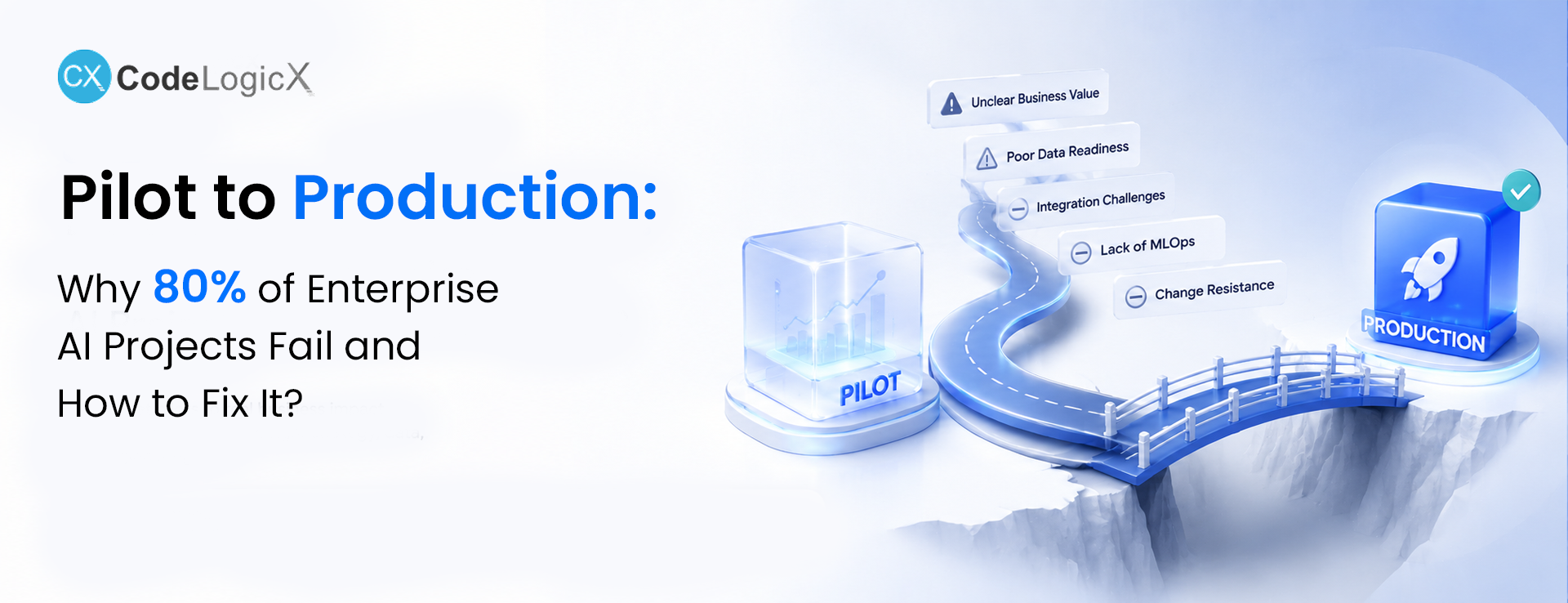
Gartner’s analysis of hundreds of generative AI implementations identified five recurring failure points. RAND’s interviews with 65 experienced data scientists and engineers, and MIT’s field research across 300+ AI deployments, describe the same five failure modes from different vantage points. Together, they form a consistent diagnosis.
Unclear Business Value
The most common failure mode isn’t technical; it’s a project launched without a specific, measurable outcome attached to it. Organizations chase visible use cases or deploy AI broadly and simultaneously, diluting resources across dozens of low-impact pilots instead of committing a few that map to revenue, cost, or risk.
McKinsey’s data shows the divide starkly: high-performing organizations are 3.6× more likely to pursue AI for transformative change, while the rest default to generic efficiency plays the first thing cut when budgets tighten.
Data That Isn’t Production-Ready
A pilot can run on a curated, hand-picked dataset. Production cannot. Fragmented systems, inconsistent metric definitions across departments, and ungoverned pipelines produce unreliable retrieval-augmented generation and models nobody trusts to fine-tune. MIT researchers frame this as a “learning gap”: most GenAI systems in production don’t retain feedback, adapt to institutional context, or improve with use so every session starts from zero, and every edge case still needs a human.
Costs That Escalate Beyond the Business Case
Each token costs look negligible in a pilot. Multiplied across thousands of users and hundreds of use cases, they become a total-cost-of-ownership problem the board notices. Organizations that don’t build FinOps discipline model routing, prompt caching, and usage visibility into the architecture from day one routinely discovers in month five that a project scoped for six months needs another six to become financially viable. By then, sponsorship has usually moved on.
Governance Treated as an Afterthought
RAND’s interviews point to what its researchers describe as a governance paradox: the organizations racing fastest to deploy AI often have the least mature controls over what it’s allowed to do. Without clear ownership for safety, privacy, accountability, and fairness, a single bad output a hallucinated figure, a biased recommendation, an exposed record can be enough for legal or the board to shut the whole initiative down, regardless of how well it otherwise performed.
Change Management Nobody Owns
The best model in the world adds no value if nobody uses it. RAND’s research describes a trust deficit between the teams building AI systems and the employees expected to rely on them. Without a deliberate plan to redesign workflows, address job-security anxiety, and prove the tool augments rather than threatens, usage quietly drops off once the launch announcement fades and the business capture only a fraction of the value the pilot promised.
The organizations closing the gap are not the ones with better model access every serious competitor can license the same frontier models. What separates them is a small, well-documented set of habits. McKinsey’s “AI high performers” roughly 6% of the organizations it surveyed are 3.6× more likely to pursue transformation rather than incremental efficiency, redesign the underlying workflow rather than bolt AI onto the existing one, and treat cost, risk, and adoption as first-class parts of the architecture rather than problems for later.
That gap compounds. Every quarter a competitor spends in production while a business is still validating a pilot is a quarter of learning, data, and workflow advantage that doesn’t come back. Standing still doesn’t preserve optionality; it quietly cedes it.
The Pilot-to-Production Framework: How to Fix It?
Closing the gap doesn’t require a different model. It requires engineering the same five failure points into strengths, deliberately, before the pilot ever starts.
Anchor to a business outcome before writing a line of code
Every initiative should map to a specific revenue, cost, or risk metric with an accountable owner not a technology KPI like “model accuracy.” Prioritize a small number of high-value use cases over a wide spread of visible ones and be willing to kill anything that can’t show a path to that metric within a defined window.
Engineer the data foundation as product, not plumbing
Treat the data layer pipelines, vector stores, knowledge graphs, governance as a first-class deliverable with its own roadmap, not a dependency to handle once the model is chosen. Systems that retain feedback and adapt to institutional context close to MIT’s learning gap and are the clearest differentiator between pilots that scale and pilots that stall.
Build FinOps and architecture discipline from day one
Model routing to right-sized models, prompt caching, and continuous cost-to-value tracking belong in the initial architecture, not a retrofit. Educate finance and business stakeholders on how token and inference costs scale with usage before they’re surprised by a production bill.
Define safety, privacy, accountability, and fairness requirements alongside functional requirements, including a clear answer to where the system should not be used at all. Build observability, audit trails, and human escalation paths before launching, not after an incident of force question.
Resource change management like a workstream, not an afterthought
Budget and staff for adoption the same way you budget for engineering. Involve the people whose workflows will change in design and testing, communicate clearly what the tool is and isn’t for, and measure adoption and trust as deliberately as you measure model performance.
Organizations that apply this discipline consistently move initiatives from proof of concept to production and keep them there at a markedly higher rate than those that treat production as a formality once the demo succeeds.
How CodeLogicX Helps?
CodeLogicX has spent over a decade helping enterprises and high-growth businesses turn ambitious technology bets into systems that hold up in production. Our approach to AI engagements is built around the same five disciplines this blog describes:
Aligning AI with Business Objectives
We begin every engagement by identifying the business problem before selecting the technology solution. Rather than deploying AI for its novelty, we work with stakeholders to define clear success metrics, prioritize high-value use cases, and create implementation of roadmaps that align with strategic goals. This ensures that AI initiatives deliver tangible ROI and support long-term business growth.
Building a Strong Data Foundation
AI systems are only as effective as the data that powers them. CodeLogicX helps organizations assess, consolidate, and prepare their data ecosystems to support reliable AI outcomes. From data engineering and governance frameworks to integration and quality assurance, we establish the foundations required for scalable and trustworthy AI applications.
Engineering AI for Production Scale
Many AI initiatives stall after successful pilots because they lack the architecture needed for enterprise deployment. Our engineering teams design and build AI solutions with scalability, performance, security, and maintainability in mind from day one. Whether deploying custom models, integrating foundation models, or creating AI-powered applications, we focus on systems that perform reliably under real-world conditions.
Embedding Governance, Security, and Responsible AI
As AI adoption accelerates, organizations must balance innovation with risk management. CodeLogicX incorporates governance, compliance, and responsible AI principles throughout the development of lifecycle. We help businesses establish controls for data privacy, model transparency, security, auditability, and regulatory compliance, ensuring that AI solutions are both effective and trustworthy.
Driving Adoption and Continuous Improvement
The success of an AI initiative ultimately depends on user adoption and ongoing optimization. We work closely with business and technical teams to integrate AI into existing workflows, enable stakeholders through training and change management, and establish monitoring frameworks for continuous improvement. This ensures that AI systems evolve alongside changing business needs and consistently deliver value over time.
End-to-End AI Transformation Partner
Beyond technical implementation, CodeLogicX serves as a strategic partner throughout the AI journey, from opportunity assessment and solution design to deployment, governance, and optimization. By combining deep engineering expertise with a practical understanding of business challenges, we help organizations build AI capabilities that are not only innovative but also resilient, scalable, and aligned with long-term business objectives.
In an environment where many AI projects struggle to move beyond proof-of-concept, CodeLogicX helps businesses bridge the gap between experimentation and enterprise-wide impact, turning AI potential into sustainable competitive advantage. Let’s sum it up with the below pointers:
- Product Engineering teams that scope AI initiatives against a business outcome first, and a technology stack second.
- AI/ML specialists who design the data and feedback loops production need not just the demo.
- Data Analytics practitioners who treat the data foundation as a governed, production-grade asset from day one.
- Quality Engineering discipline that stress-tests cost, performance, and failure modes before they become a customer’s problem.
Whether you’re scoping your first AI pilot or trying to understand why the last three never made it production, that’s the conversation worth having before the next one starts.
Conclusion
None of the five research organizations behind the statistics in this blog found that enterprise AI is a technology problem. They found operating discipline problems with a well-documented, repeatable fix. The organizations on the right side of the GenAI Divide aren’t the ones with privileged model access. They’re the ones who treated data, cost, governance, and change management as engineering problems worth solving before the pilot began, not issues to manage once it succeeded.